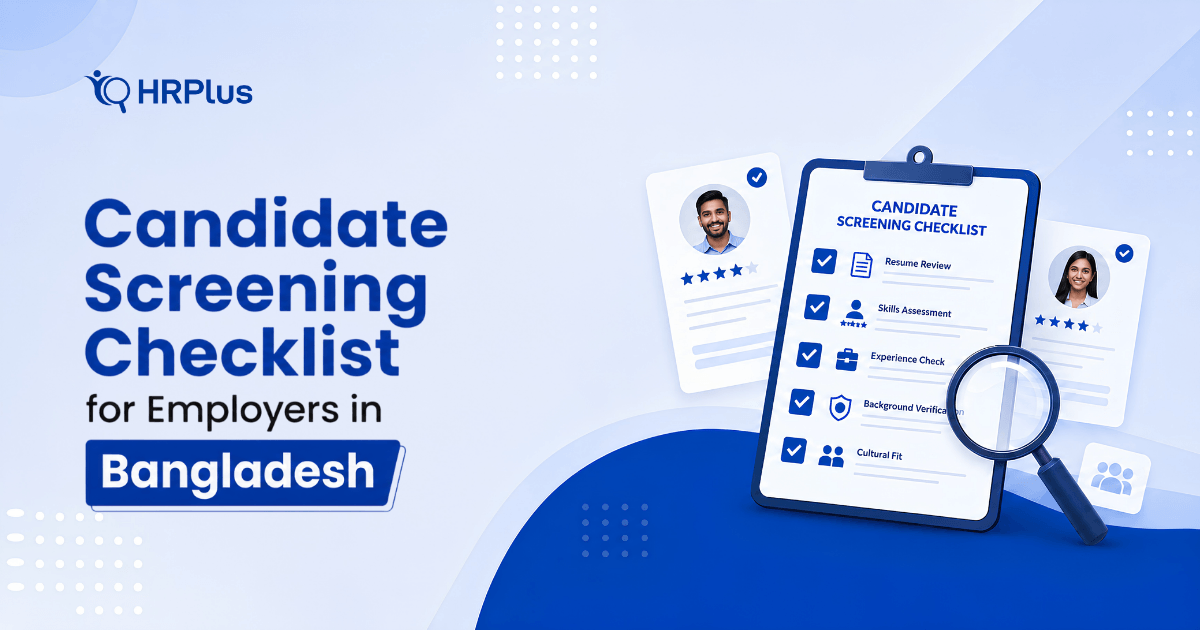
Candidate Screening Checklist for Employers in Bangladesh
Use this candidate screening checklist Bangladesh guide to reduce wrong hires, improve CV screening, assess candidates, and hire better employees.
Introduction
Hiring the wrong employee can create operational delays, increase recruitment costs, reduce team productivity, and place additional pressure on managers. A structured candidate screening checklist for employers in Bangladesh helps organizations make hiring decisions based on evidence rather than assumptions or first impressions.
Many employers in Dhaka and other business centres receive hundreds of applications for a single vacancy. However, a high number of applications does not necessarily produce a strong shortlist. CVs may contain incomplete information, responsibilities may be overstated, and candidates who look suitable on paper may not match the actual requirements of the position.
Effective screening should therefore go beyond checking educational qualifications and years of experience. Employers should evaluate relevant achievements, technical ability, communication, motivation, salary expectations, employment history, cultural alignment, and potential risks.
This guide explains how employers can build a consistent candidate screening process, shortlist applicants objectively, conduct preliminary assessments, verify critical information, and reduce avoidable hiring mistakes.
Quick Answer: What Should Employers Check When Screening Candidates?
Candidate screening is the process of evaluating job applicants against predefined selection criteria before inviting them to the next stage of recruitment. Employers should review qualifications, relevant experience, competencies, achievements, career history, salary expectations, availability, integrity, and overall suitability for the position.
A reliable screening checklist should cover:
- Mandatory job requirements
- Relevant experience and measurable achievements
- Technical and behavioural competencies
- Employment history and career progression
- Salary, location, notice period, and availability
- Reference and background verification
- Motivation, communication, and organizational fit
What Is Candidate Screening?
Candidate screening is the systematic evaluation of job applicants to determine whether they meet the essential requirements of a vacancy. It usually includes CV review, preliminary interviews, skills assessments, employment-history checks, and reference verification.
Screening is different from final selection. Its purpose is to identify which applicants deserve further consideration and which applicants do not meet the established requirements.
A structured screening process allows employers to:
- Remove clearly unsuitable applications
- Rank qualified candidates consistently
- Reduce interviewer bias
- Save hiring managers’ time
- Identify discrepancies early
- Improve the quality of the final shortlist
In Bangladesh, the screening approach should reflect the position, industry, organizational risk, and level of seniority. Screening a junior customer service executive will not require the same depth as screening a chief financial officer, plant head, compliance manager, or senior engineering professional.
Business insight: The objective is not to identify the candidate with the most impressive CV. The objective is to identify the candidate whose qualifications, behaviour, motivation, and experience are most closely aligned with the actual business requirement.
Why Is Candidate Screening Important for Employers in Bangladesh?
Candidate screening is important because it prevents unsuitable applicants from progressing through a time-consuming interview and approval process. It also gives hiring managers better evidence for comparing candidates.
Bangladesh has a large and diverse labour market. Employers recruit through job portals, social media, employee referrals, recruitment agencies, university networks, professional associations, and personal contacts. This variety can increase access to talent, but it can also produce inconsistent applicant information.
A proper screening process helps employers address several common challenges.
High Application Volumes
Employers may receive hundreds of CVs for administrative, sales, finance, customer service, human resources, and entry-level management positions. Without objective criteria, recruiters may reject strong applicants or spend excessive time reviewing unsuitable profiles.
Inconsistent CV Information
Candidates use different CV formats and may describe similar responsibilities in very different ways. Job titles also vary considerably between organizations. For example, an “Assistant Manager” in one company may have responsibilities similar to those of a “Senior Executive” in another.
Employers must assess the actual scope of responsibility rather than relying only on job titles.
Unverified Employment Claims
CVs may contain inaccurate dates, inflated responsibilities, unclear reasons for leaving, or achievements that cannot be verified. Screening allows employers to clarify these issues before making an offer.
Pressure to Fill Vacancies Quickly
Urgent vacancies often encourage employers to shorten the assessment process. This may reduce time-to-hire temporarily but increase the risk of poor performance, early resignation, or replacement hiring.
Compliance and Fairness
Screening criteria should be relevant to the job and applied consistently. Employers should avoid discriminatory or irrelevant decisions and maintain appropriate confidentiality when handling candidate information.
The International Labour Organization’s principles on equality at work provide a useful international framework for fair employment practices. Employers should also review applicable requirements under the Ministry of Labour and Employment and current Bangladesh labour legislation before implementing employment policies.
How Does the Candidate Screening Process Work?
A candidate screening process should move from broad eligibility checks to deeper assessments. Each stage should eliminate uncertainty and provide evidence for the hiring decision.
1. Confirm the Hiring Requirement
Before reviewing CVs, the recruiter and hiring manager should agree on:
- Purpose of the position
- Major responsibilities
- Reporting line
- Mandatory qualifications
- Required technical skills
- Minimum relevant experience
- Preferred industry exposure
- Salary range
- Work location
- Working schedule
- Performance expectations
A poorly defined requirement will produce an inconsistent shortlist, regardless of how experienced the recruiter is.
2. Separate Mandatory and Preferred Criteria
Mandatory requirements are conditions without which a candidate cannot perform or legally hold the role. Preferred criteria improve suitability but should not automatically disqualify an applicant.
For example:
Mandatory criteria may include:
- Professional certification required for the position
- Experience operating a specific machine or system
- Minimum years of relevant functional experience
- Legal authorization to work
- Willingness to work at the required location
Preferred criteria may include:
- Experience in the same industry
- Knowledge of an additional software platform
- Exposure to multinational organizations
- Experience managing a larger team
Separating these categories prevents employers from rejecting strong candidates simply because they do not match every desirable condition.
3. Review Applications Against a Scorecard
Every CV should be reviewed against the same criteria. A basic scorecard may assess:
- Education
- Relevant experience
- Functional knowledge
- Industry exposure
- Leadership experience
- Career stability
- Evidence of achievement
- Communication quality
- Location and availability
- Salary alignment
The importance of each factor should depend on the role.
4. Conduct a Preliminary Screening Call
A 15- to 30-minute screening conversation can clarify important information that is not apparent from the CV.
The recruiter should confirm:
- Current responsibilities
- Reason for considering a change
- Relevant accomplishments
- Reporting relationship
- Team size
- Current and expected compensation
- Notice period
- Work-location acceptance
- Career motivation
- Communication ability
5. Administer Relevant Assessments
Depending on the role, employers may use:
- Technical tests
- Case studies
- Writing exercises
- Excel or data-analysis tests
- Sales presentations
- Language assessments
- Problem-solving exercises
- Behavioural questionnaires
- Work-sample simulations
Bdjobs, for example, provides employers with online testing options, including multiple-choice and descriptive assessments. Employers should ensure that every test measures capabilities genuinely required for the position.
6. Conduct Structured Interviews
Candidates should be asked comparable core questions. Structured interviews improve consistency and make it easier to compare evidence.
7. Verify Critical Information
Before issuing a final offer, verify the information that could materially affect the hiring decision.
This may include:
- Employment dates
- Previous designation
- Reporting line
- Major responsibilities
- Academic qualifications
- Professional certifications
- References
- Identity documentation
- Right-to-work documentation where applicable
8. Document the Selection Decision
The final decision should explain why the selected candidate meets the requirement better than the alternatives.
Complete Candidate Screening Checklist for Employers in Bangladesh
The following checklist can be used by recruiters, HR professionals, business owners, and hiring managers.
1. Job Requirement Alignment
Confirm whether the candidate:
- Meets the mandatory educational requirement
- Has the required professional certification
- Has sufficient relevant experience
- Understands the main responsibilities
- Has worked at an appropriate level of responsibility
- Accepts the reporting relationship
- Can work at the required location
- Can follow the required working schedule
- Meets any legally required occupational conditions
Expert tip: Avoid rejecting candidates solely because their previous job title is different. Compare responsibilities, complexity, authority, and measurable outcomes.
2. CV Quality and Accuracy
Review whether:
- Employment dates are clearly stated
- Job titles and organizations are identifiable
- Responsibilities are relevant and specific
- Achievements are distinguished from routine duties
- Career gaps are explainable
- Qualifications are consistently presented
- Contact information is current
- There are unexplained overlaps between jobs
- The CV contains contradictory information
Minor formatting problems should not automatically disqualify an otherwise qualified candidate. However, material inconsistencies should be clarified.
3. Relevant Experience
Assess:
- Total years of experience
- Years of directly relevant experience
- Industry exposure
- Functional specialization
- Complexity of previous responsibilities
- Size of operations handled
- Team-management experience
- Customer, vendor, or stakeholder exposure
- Experience with similar business challenges
For senior positions, focus on decision-making authority and business impact rather than years of service alone.
4. Measurable Achievements
Look for evidence that the candidate has delivered results.
Examples include:
- Reduced operating costs
- Improved production output
- Increased sales
- Reduced employee turnover
- Shortened process timelines
- Improved audit results
- Implemented a new system
- Expanded a territory
- Built or restructured a team
- Improved compliance performance
Ask candidates to explain the situation, their specific responsibility, the action they took, and the result.
5. Technical Competency
Determine whether the candidate can perform the essential technical elements of the role.
Technical screening may cover:
- Industry-specific knowledge
- Software proficiency
- Machinery or equipment knowledge
- Regulatory understanding
- Reporting capability
- Analytical ability
- Financial or commercial knowledge
- Project-management skills
- Quality and safety knowledge
Do not accept self-reported proficiency without evidence when the skill is critical to the position.
6. Behavioural Competency
Evaluate behaviours connected to successful job performance, such as:
- Accountability
- Problem-solving
- Collaboration
- Adaptability
- Integrity
- Customer orientation
- Attention to detail
- Decision-making
- Conflict management
- Leadership
Behavioural interview questions should ask for specific examples from previous experience.
For example:
“Tell us about a time when you had to deliver a critical assignment with limited resources. What did you do, and what was the result?”
7. Communication Ability
Assess whether the candidate can communicate at the level required for the role.
Check:
- Clarity of explanation
- Listening ability
- Professional tone
- Written communication
- Presentation ability
- Ability to simplify complex information
- Ability to communicate with senior stakeholders
- Relevant Bangla and English proficiency
Communication standards should match the position. A customer-facing executive, technical specialist, factory supervisor, and finance controller will require different communication capabilities.
8. Career History and Stability
Review:
- Length of service in previous roles
- Frequency of job changes
- Reasons for leaving
- Promotions or increased responsibilities
- Employment gaps
- Movement between unrelated functions
- Patterns of resignation during probation
- Consistency between career objectives and the vacancy
Frequent job changes should be explored rather than treated as automatic rejection. Contract assignments, restructuring, relocation, project completion, organizational closure, family circumstances, and career advancement can all be legitimate explanations.
9. Motivation and Career Interest
Determine:
- Why the candidate applied
- What they understand about the position
- Why they want to leave their current organization
- What type of work motivates them
- Whether their long-term direction matches the opportunity
- Whether they are primarily attracted by salary, title, learning, stability, or responsibility
- Whether their expectations are realistic
A technically qualified candidate may still leave early if the role does not meet their actual career expectations.
10. Compensation Alignment
Confirm:
- Current gross salary
- Fixed and variable components
- Bonuses
- Provident fund, gratuity, insurance, transport, and other benefits
- Expected compensation
- Minimum acceptable package
- Whether the candidate has competing offers
- Whether expectations fit the approved budget
Employers should compare the total employment package, not only monthly salary.
11. Notice Period and Availability
Confirm:
- Official notice period
- Whether the notice period is negotiable
- Earliest possible joining date
- Existing contractual obligations
- Planned leave or travel
- Relocation requirements
- Whether the candidate can attend the required selection stages
Do not pressure candidates to violate existing contractual obligations.
12. Location and Working Conditions
Ensure that the candidate understands:
- Exact job location
- Travel requirements
- Factory or field exposure
- Shift duties
- Weekend arrangements
- Remote or on-site expectations
- Transfer possibilities
- Transportation limitations
- Physical requirements where genuinely relevant
For positions outside central Dhaka, location acceptance should be verified early. Many offers fail because travel time, family circumstances, or relocation conditions are discussed too late.
13. Reference Checks
Reference checks should be conducted with appropriate consent and preferably after the candidate reaches the final stage.
Ask former supervisors or authorized representatives about:
- Employment period
- Designation
- Reporting line
- Key responsibilities
- Performance
- Reliability
- Conduct
- Leadership or teamwork
- Reason for departure
- Eligibility for re-employment
References should be treated as one source of evidence, not the sole basis for a decision.
Some employers, especially development organizations and safeguarding-sensitive institutions, apply additional pre-employment checks based on the risk profile of the position. Publicly available recruitment notices from organizations operating in Bangladesh show that reference, safeguarding, and misconduct-related checks may form part of their selection process.
14. Background and Document Verification
Depending on role-related risk, employers may verify:
- National identity
- Academic certificates
- Professional membership
- Previous employment
- Address
- Driving licence
- Criminal-record information where legally appropriate
- Financial integrity for sensitive positions
- Work authorization for foreign nationals
Screening must be relevant, proportionate, confidential, and conducted with appropriate authorization.
Foreign nationals may require separate work-permit and visa documentation. Employers should consult the Bangladesh Investment Development Authority’s work-permit guidance or the applicable authority for the organization’s sector. BIDA’s published requirements include organizational, immigration, authorization, and employment-related documents for relevant foreign workers.
15. Potential Risk Indicators
Investigate, rather than immediately assume wrongdoing, when you identify:
- Inconsistent employment dates
- Unexplained role inflation
- Qualifications that cannot be verified
- Refusal to provide reasonable information
- Significant differences between CV and interview statements
- Unclear reasons for leaving several positions
- Unrealistic claims of individual achievement
- Negative comments about every previous employer
- Confidential information shared from a current employer
- Reference contacts who cannot confirm basic employment facts
A concern should be evaluated through evidence and clarification, not intuition alone.
How Should Employers Screen CVs Efficiently?
Employers can screen CVs efficiently by using a three-stage review rather than reading every application in equal depth.
Stage One: Eligibility Review
Check only mandatory criteria:
- Required qualification
- Minimum relevant experience
- Work location
- Essential certification
- Legal eligibility
- Critical technical requirement
Applications that clearly fail mandatory conditions can be removed.
Stage Two: Relevance Review
Evaluate:
- Similar responsibilities
- Industry exposure
- Achievements
- Career progression
- Technical skills
- Team or project size
- Business environment
Stage Three: Comparative Review
Compare the strongest candidates using a consistent scorecard.
Classify applicants as:
- Strong shortlist
- Potential shortlist
- Hold for clarification
- Not suitable for this vacancy
- Suitable for another position
This process improves speed without reducing screening quality.
For a broader understanding of professional hiring support, employers can review the complete guide to recruitment services in Bangladesh.
What Candidate-Screening Mistakes Should Employers Avoid?
Screening Without an Approved Job Description
When hiring managers and recruiters have different expectations, unsuitable candidates enter the process and qualified candidates may be rejected.
Solution: Finalize responsibilities, selection criteria, salary range, reporting line, and decision-making authority before sourcing.
Selecting Candidates Based Only on CV Keywords
A candidate may mention a keyword without having meaningful experience, while another candidate may describe relevant experience using different terminology.
Solution: Assess context, scope, actions, and outcomes.
Overemphasizing Years of Experience
Ten years of repetitive experience may be less valuable than five years of progressively complex responsibility.
Solution: Evaluate depth, complexity, achievements, and decision-making exposure.
Allowing Personal Bias to Influence Screening
Educational institution, home district, age assumptions, personal similarity, or previous company reputation can influence judgment without predicting performance.
Solution: Use job-related criteria and structured scoring.
Conducting Unstructured Screening Calls
Casual conversations produce different information from each candidate and make comparison difficult.
Solution: Use a standard question set while allowing role-specific follow-up questions.
Ignoring Candidate Motivation
Candidates may accept an offer that does not support their real career goals and resign shortly afterwards.
Solution: Discuss expectations, motivation, working conditions, and development opportunities openly.
Checking References Too Late
A serious discrepancy discovered after approval can restart the entire recruitment process.
Solution: Complete critical verification before the final offer, subject to consent and organizational policy.
Sharing Candidate Information Unnecessarily
CVs contain personal and professional information that should not be circulated without a legitimate recruitment purpose.
Solution: Restrict access to authorized decision-makers and maintain secure records.
What Are the Best Practices for Fair and Consistent Screening?
Employers should apply the following practices:
- Use criteria directly connected to job performance.
- Apply the same core screening criteria to all candidates.
- Record evidence supporting every shortlist decision.
- Train interviewers on structured assessment.
- Separate mandatory requirements from preferences.
- Obtain consent before conducting sensitive checks.
- Protect candidate confidentiality.
- Allow candidates to clarify material discrepancies.
- Use multiple assessment methods for critical roles.
- Review the process after every major hire.
Employment decisions should not be based on irrelevant personal characteristics. The ILO identifies equality and non-discrimination as important principles of fair employment, including recruitment and employment conditions.
Expert tip: Screening quality improves when the recruiter and hiring manager conduct an early calibration meeting using two or three sample CVs. This quickly reveals whether both parties interpret the requirements in the same way.
When Should Employers Use a Recruitment Agency for Candidate Screening?
Employers should consider professional recruitment support when internal teams lack the time, market access, assessment capability, or specialist knowledge required for the vacancy.
External support can be valuable when:
- The role is senior or confidential
- Suitable candidates are not actively applying
- The vacancy requires specialist expertise
- Internal recruiters are managing many positions
- The organization needs a rapid shortlist
- Previous recruitment attempts were unsuccessful
- The employer is entering a new sector
- Objective candidate assessment is required
- The position carries significant operational risk
A professional recruitment agency should do more than collect and forward CVs. It should clarify the requirement, search relevant talent pools, assess candidates, document fit, coordinate interviews, and support verification and offer management.
Employers considering external support can also read how to choose the best recruitment agency in Bangladesh before appointing a service provider.
Candidate Screening Checklist: Final Review Before Shortlisting
Before moving a candidate to the formal interview stage, confirm that:
- The candidate meets all mandatory requirements.
- Relevant experience has been identified.
- Achievements have been discussed or documented.
- Employment dates are reasonably consistent.
- Career gaps or frequent transitions have been clarified.
- Technical capability appears appropriate.
- Communication meets the role requirement.
- Motivation is aligned with the opportunity.
- Salary expectations fit the approved range.
- Notice period is acceptable.
- Location and working schedule have been discussed.
- No major unresolved discrepancy remains.
- Screening notes are documented.
- The reason for shortlisting is clear.
Before making the final offer, additionally confirm that:
- Required assessments have been completed.
- Interview feedback is documented.
- Qualifications have been checked where necessary.
- Employment references have been completed.
- Background checks are appropriate and complete.
- Compensation approval has been obtained.
- Joining conditions are clearly communicated.
- Candidate information remains confidential.
Future Trends in Candidate Screening in Bangladesh
Candidate screening in Bangladesh is becoming more structured, technology-assisted, and evidence-based. Employers are increasingly using applicant tracking systems, video interviews, online assessments, digital reference checks, and competency-based evaluation.
AI-Assisted CV Screening
Artificial intelligence can help organize applications and identify profiles containing relevant experience. However, employers should not allow automated screening to make unchecked final decisions.
Algorithms may overlook transferable skills, unconventional career paths, or qualified candidates whose CVs use different terminology.
Skills-Based Hiring
More organizations are placing greater importance on demonstrated ability rather than relying only on degrees, job titles, or years of experience.
This approach is particularly relevant in:
- Software development
- Digital marketing
- Data analytics
- Sales
- Design
- Technical operations
- Customer experience
- Project management
Greater Emphasis on Verification
As remote recruitment and digital applications increase, employers are likely to strengthen qualification, employment, identity, and reference verification.
Candidate Experience
Strong candidates often participate in several recruitment processes simultaneously. Employers that provide clear communication, reasonable timelines, and transparent expectations are more likely to secure preferred applicants.
Data-Informed Recruitment
Organizations are beginning to monitor:
- Application-to-shortlist ratio
- Shortlist-to-interview ratio
- Interview-to-offer ratio
- Offer acceptance
- Joining ratio
- Time-to-fill
- Early turnover
- Source effectiveness
- Performance after hiring
The future of candidate screening will not depend on technology alone. The most effective systems will combine digital efficiency with informed human judgment.
Frequently Asked Questions
What is the first step in candidate screening?
The first step is to define the job requirement. Employers should confirm the position’s responsibilities, mandatory qualifications, relevant experience, technical competencies, salary range, location, and expected results before reviewing applications.
How long should a candidate screening call take?
A preliminary screening call generally takes between 15 and 30 minutes. Senior, technical, or highly specialized positions may require a longer conversation to assess responsibilities, achievements, leadership scope, and career motivation.
Should employers verify every candidate’s educational qualifications?
The level of verification should depend on the role and organizational risk. Employers should verify qualifications when a degree, licence, certification, or professional membership is essential to performing the job or meeting regulatory requirements.
Can employers reject candidates because of frequent job changes?
Frequent job changes can justify further questions, but they should not lead to automatic rejection. Employers should consider contract work, company closure, restructuring, career advancement, relocation, workplace conditions, and personal circumstances before making a decision.
What should employers ask during reference checks?
Employers should confirm employment dates, designation, reporting line, responsibilities, performance, reliability, conduct, reason for leaving, and eligibility for re-employment. Questions should remain relevant to the position.
Is background verification necessary for every employee?
Not every position requires the same level of background verification. The checks should reflect the employee’s access to money, confidential information, children, vulnerable people, safety-critical operations, regulated activities, or senior decision-making authority.
What is the difference between screening and interviewing?
Screening determines whether a candidate meets the basic and preferred requirements for further consideration. Interviewing explores competencies, behaviour, technical understanding, motivation, and overall suitability in greater depth.
Can small businesses use a candidate screening checklist?
Yes. A checklist is particularly useful for SMEs and startups because it reduces reliance on informal judgment. Even a simple structured process can improve consistency, save management time, and reduce costly hiring mistakes.
Conclusion
A structured candidate screening checklist for employers in Bangladesh helps organizations reduce hiring risk, improve shortlist quality, and make more defensible recruitment decisions.
Effective screening should cover more than qualifications and years of experience. Employers must assess relevant achievements, technical capability, behavioural competencies, motivation, communication, career history, salary expectations, availability, references, and role-specific risks.
The most reliable process begins with a clearly defined job requirement, applies consistent assessment criteria, documents evidence, and verifies critical information before an offer is issued.
Organizations that lack the time, internal resources, or specialist network to screen candidates thoroughly may benefit from professional recruitment support. HRPlus helps employers search, screen, assess, and shortlist suitable professionals for mid-level, senior, specialist, and leadership positions across Bangladesh.
Looking for qualified candidates rather than a large collection of CVs? Contact HRPlus to discuss a structured candidate search and assessment process for your next critical hire.